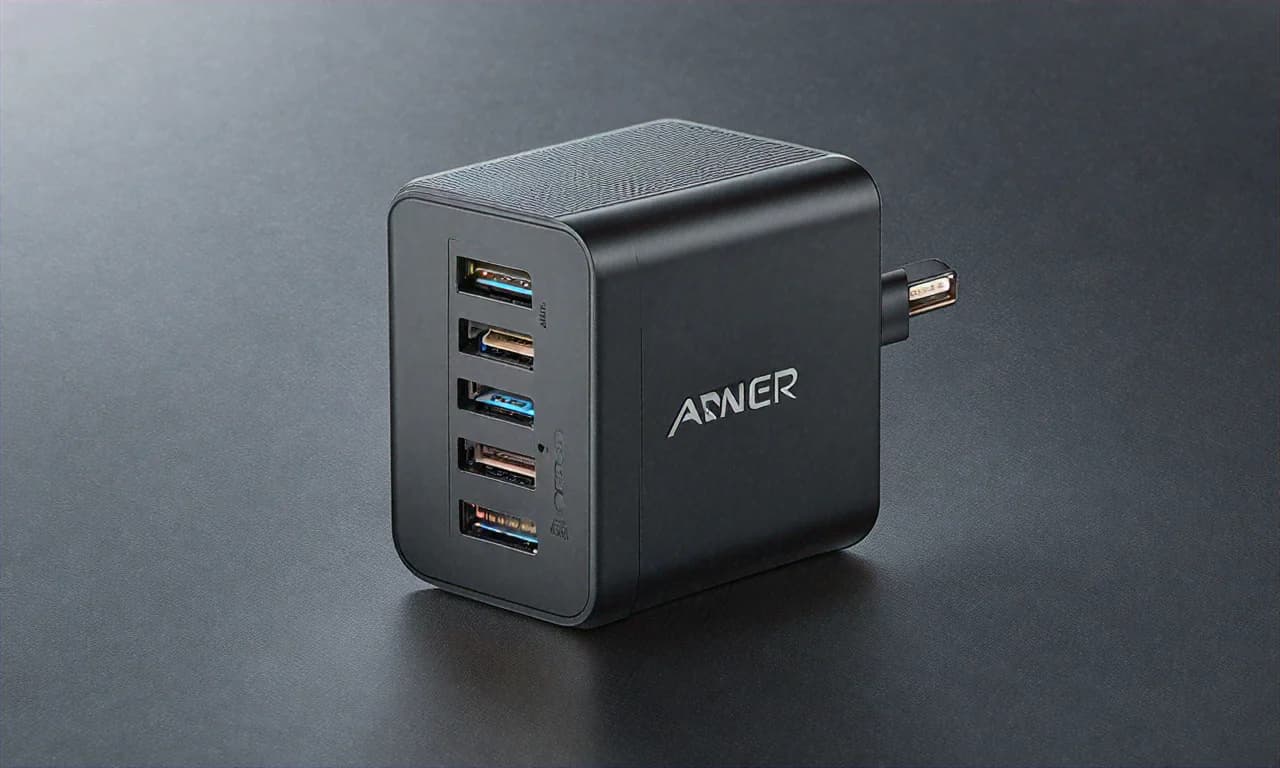
Anker Nano 67W GaN Charger at Rs 3,499 on Amazon India — The Only Charger You Actually Need?
Let me paint you a picture. It's 6 AM at Bengaluru airport. You're rushing to catch a flight to Delhi for a client meeting. Your laptop bag has one of those tangled messes inside — the MacBook charger (which is the size of a small brick), a separate phone charger, a USB-C cable for your tablet, and somehow your earbuds charger got thrown in there too. The zipper barely closes. You have been living this life for years, carrying around what feels like a kilo of chargers every single trip. That was me until about eight months ago when I picked up the Anker Nano 67W GaN Charger. And honestly? It has been one of those purchases where you wonder why you didn't do this sooner.
Amazon India currently has this listed at Rs 3,499, which is 30% off the MRP of Rs 4,999. If you have an SBI or ICICI credit card, there is an additional 10% instant discount on select electronics, which could bring the effective price down to around Rs 3,150 or even lower depending on the ongoing bank promotion. That's honestly cheap for a charger that can power your laptop, phone, and tablet — all at the same time, from a single wall socket.
Why I Switched to a GaN Charger (And What GaN Even Means)
Okay so before I talk about this specific Anker model, let me quickly explain what GaN is because I keep seeing people on Twitter and Reddit confused about it. GaN stands for Gallium Nitride. It's a type of semiconductor material — basically the stuff that goes inside the charger to convert AC power from your wall socket into DC power for your devices. Traditional chargers use silicon for this. Silicon works fine but it's bulky and generates more heat. GaN can handle higher voltages and frequencies in a much smaller package while staying cooler. That's the simple version.
The practical result? A charger that pushes out 67 watts of power but is barely bigger than the little 20W Apple charger that comes with... well, nothing these days because Apple stopped including chargers. You get the point. It's tiny. Like, truly tiny. I remember the first time I held it, I thought there was no way this little thing could charge my MacBook Air. But it does. Fully. Without breaking a sweat.
I'd been using the stock Apple 67W charger before this and the size difference is almost comical. The Anker is maybe 50% smaller. Maybe more. You can literally put it in your jeans pocket if you wanted to, though I wouldn't recommend that because the prongs might poke you. Speaking of which — the prongs fold in. Flat. Flush with the body. That is a detail that matters more than you think when you're stuffing things into bags at airport security.
Three Ports, One Charger — How the Power Distribution Works
This is where it gets interesting and also where some people get confused so let me break it down clearly. The Anker Nano 67W has three ports. Two USB-C ports and one USB-A port. When you're using just one USB-C port by itself, you get the full 67W. That's enough to fast-charge a MacBook Air, a Dell XPS 13, a Lenovo ThinkPad, most ultrabooks basically. My MacBook Air M2 charges from 20% to full in about an hour and forty minutes with this charger. Not the fastest in the world but perfectly fine for my needs.
Now here's the thing. When you plug in a second device, the power gets split. Anker calls it "intelligent power distribution" which is a fancy way of saying the charger figures out which device needs more power and allocates accordingly. In practice, if I have my MacBook on one USB-C port and my iPhone on the other, it usually does something like 45W to the laptop and 20W to the phone. Which is honestly perfect because 20W is already the maximum fast-charging speed for iPhones anyway.
If all three ports are occupied — say laptop, phone, and Galaxy Buds on the USB-A port — the distribution shifts to roughly 20W + 20W + 22.5W. Your laptop will charge slower in this scenario, yes. But your phone and earbuds will still charge at their maximum supported speeds. I tested this during a layover at Mumbai airport once. Plugged in all three devices, went to grab a Vada Pav from the food court, came back thirty minutes later and my phone had gone from 30% to about 75%. The MacBook had moved up maybe 15 percentage points. Not blazing fast for the laptop but way better than having it just sit there dying.
Fast Charging Protocols — It Speaks Every Language
One thing I really appreciate about Anker chargers in general is that they support basically every fast charging protocol out there. This one does USB Power Delivery 3.0, PPS (Programmable Power Supply), and Qualcomm Quick Charge 4+. What does that mean in practical terms? It means this charger will fast-charge your iPhone, your Samsung Galaxy, your Pixel, your OnePlus (through PPS), your iPad, your MacBook, your Windows laptop — basically anything that charges over USB-C. I've tested it with my friend's Samsung Galaxy S24 Ultra and it triggered 45W Super Fast Charging through PPS. Worked perfectly.
The USB-A port maxes out at 22.5W which covers Qualcomm Quick Charge and also supports Huawei's SCP protocol if you happen to have a Huawei device. Most people will use the USB-A port for slower-charging accessories like earbuds, smartwatches, or older devices, and 22.5W is more than enough for all of those.
Build Quality and Daily Use — Eight Months Later
I've been using this charger pretty much every single day for about eight months now. At home, at work, at coffee shops, during travel. Here's what I've noticed.
The build quality is solid. It's made of a matte dark grey plastic that doesn't pick up fingerprints or scratches easily. After eight months of being thrown into bags, the only sign of wear is a very faint scuff near the bottom that you wouldn't notice unless you were looking for it. The foldable prongs still snap firmly into both positions — folded and extended. No looseness whatsoever. The USB-C and USB-A ports feel tight when you plug in cables. None of that annoying wobble that cheap chargers develop after a few months.
Heat management — this is where people worry about GaN chargers. Yes, it gets warm. When you're pulling 67W from a single port, the charger definitely heats up. I'd describe it as warm-to-the-touch but never uncomfortable-to-hold levels of hot. Anker has this feature called ActiveShield 2.0 which is essentially a temperature monitoring system. The charger checks temperature multiple times per second and adjusts output if it detects overheating. In eight months of heavy use, I've never had the charger shut down or throttle noticeably due to heat. During Delhi summers — and we are talking 45 degree days — it performed fine. My old silicon-based multi-port charger used to get genuinely hot during summers. This one stays reasonable.
One thing that took some getting used to is the size of the charger relative to Indian wall sockets. Our sockets are a bit recessed compared to American ones, and the charger sits fine in a standard 3-pin socket but it can block the adjacent socket on a multi-plug board if they're too close together. This is not unique to this charger — most wide-body chargers have this problem in India. I solved it by using a small extension cord at my desk, which I'd have used anyway.
Travelling with the Anker 67W — A Real Difference Maker
I travel between Bengaluru, Delhi, and Hyderabad roughly twice a month for work. Before this charger, my laptop bag's charger pocket was always stuffed. I carried the MacBook charger, a separate phone charger (usually Apple's 20W), and sometimes a third charger for my iPad or power bank. Three chargers, three cables, one mess.
Now I carry the Anker 67W and two cables. A USB-C to USB-C for the laptop and a USB-C to Lightning for the iPhone (yes I'm still on iPhone 14 Pro, don't judge me, the 16 is on my wishlist for Diwali). That's it. The weight savings alone are noticeable. I'm not joking — my bag feels lighter and the charger pocket actually zips shut without a fight.
Hotel rooms are another scenario where this charger shines. You know how most hotel rooms in India have maybe one or two accessible power outlets near the bed? And one of them is usually taken by the bedside lamp? With a single-port charger you're constantly swapping devices. With this, I plug in the Anker, connect my phone and laptop, set an alarm, and go to sleep. Both devices are full by morning. Simple. No outlet negotiation required.
I also took this charger on a trip to Goa last December and it survived five days of beach humidity without any issues. The foldable prongs are a blessing when you're packing light — no random metal sticking out to snag on clothes or scratch your sunglasses case.
How Does It Compare to Other Options in India?
Let me talk about alternatives because you should know what else is out there before spending Rs 3,499.
The Samsung 65W Trio Charger is a direct competitor. It's priced around Rs 3,799 on Flipkart and offers similar multi-port functionality. However, it doesn't support as many fast-charging protocols and is noticeably larger than the Anker. I've held both and the Anker feels like a generation ahead in terms of compactness.
Xiaomi has a 67W GaN charger as well, priced at around Rs 2,499. It's cheaper for sure but it only has a single USB-C port. So you're saving money but losing the multi-device charging capability which is kind of the whole point.
The Belkin 67W GaN charger is another option at around Rs 4,499 on Amazon. Belkin makes good stuff but I don't think the extra thousand rupees gets you anything meaningful over the Anker. The specs are nearly identical.
And then there's the Apple 67W USB-C charger at Rs 5,900. Single port. No foldable prongs. Bigger body. Almost double the price. I love Apple products but their chargers are actually overpriced for what you get. The Anker does everything the Apple charger does and more, for Rs 2,400 less.
Bank Offers and How to Get the Best Price
Right now on Amazon India, SBI credit card holders get 10% instant discount up to Rs 500 on electronics purchases. That alone brings this charger down to about Rs 3,149. ICICI Bank is running a similar offer — 10% cashback as reward points on Amazon purchases above Rs 3,000. If you have Amazon Pay ICICI credit card, you already get 5% back on all Amazon purchases, which would be about Rs 175 back on this charger. Not massive savings individually but they add up.
If you aren't in a rush, I would suggest waiting for the Amazon Great Indian Festival sale which typically happens around Navratri (October-ish). During the last sale, I saw this charger drop to Rs 2,799 briefly. Combine that with a bank offer and you could potentially get it for under Rs 2,500. But if you need a charger now, Rs 3,499 is already a fair price. Don't over-optimize and end up carrying four separate chargers for another six months just to save Rs 500.
Who Should Buy This and Who Should Skip It
Buy it if you carry multiple devices daily and are tired of carrying multiple chargers. Buy it if you travel frequently — even if it's just weekend trips to Lonavala or Ooty, the space savings matter. Buy it if you have a USB-C laptop that charges at 65W or below. Buy it if you want a single charger for your desk that handles everything.
Skip it if you only have one device to charge and do not see yourself adding more. A simple 20W or 30W charger would be cheaper and sufficient. Skip it if your laptop requires more than 67W — some gaming laptops and larger MacBook Pros need 96W or 140W, and this charger can't handle those. Skip it if you're very budget-conscious and a Rs 1,200 single-port fast charger would legitimately meet your needs.
Also worth noting — this charger doesn't come with any cables. Just the charger brick and a small manual. You will need to buy cables separately. Anker makes good cables (their nylon braided USB-C cables are my favourite) but that's an extra Rs 500-800 depending on length and type.
Final Thoughts After Eight Months
I'm not exaggerating when I say this is probably the most satisfying tech purchase I made all year. Not the flashiest, not the most expensive, but the one that has actually improved my daily life in a tangible way. Every morning I unplug one charger from the wall, toss it in my bag, and I know I'm covered for the entire day no matter what devices I need to charge. That simplicity is worth way more than Rs 3,499 to me. If you're still carrying around three chargers like I used to, just buy this thing. Your bag will thank you.


