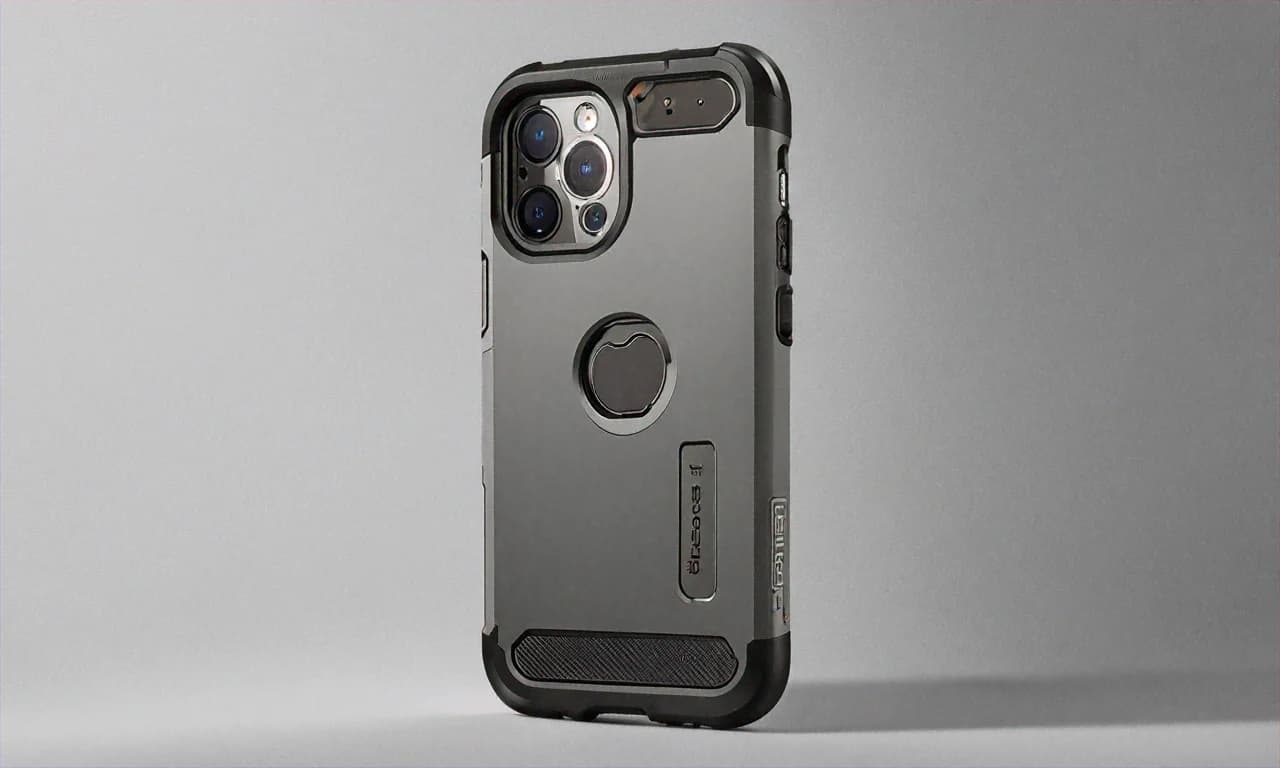
Spigen Tough Armor for iPhone 16 Pro — Rs 1,499 on Amazon, But Is It the Right Case for You?
I drop my phone. A lot. Like embarrassingly often. In the kitchen while cooking, on the tiled floor of my living room, once on the road outside a chai stall in Koramangala. That last one got a crack on my iPhone 14 Pro screen that cost me Rs 28,000 to fix at the Apple service centre. Twenty-eight thousand rupees. For a screen. After that incident, I swore I'd never use a phone without a proper case again. And Spigen's Tough Armor has been my go-to ever since.
The Tough Armor for the iPhone 16 Pro is now available on Amazon India at Rs 1,499, which is 40% off the MRP of Rs 2,499. I've been using this exact case on my iPhone 16 Pro since October, and after about five months of daily use, I've a lot to say about it — both good and bad. If you are shopping for a case for your new iPhone, this might help you decide.
Why I Keep Coming Back to Spigen
Before I get into the specifics of the Tough Armor, let me give you some context. I've tried a LOT of phone cases over the years. Cheap Rs 199 silicone cases from local shops, branded cases from Samsung's official store, leather cases, clear cases, you name it. And I keep coming back to Spigen for one simple reason — they actually protect your phone without making it feel like you're holding a brick.
Spigen is a Korean brand that has been making phone cases for over a decade. They're not exactly cheap, but they aren't absurdly expensive either. Rs 1,499 for a quality case is honestly very reasonable when you consider you're protecting an iPhone that costs Rs 1,19,900 or more. Think of it this way — the case costs roughly 1.25% of your phone's value. If it saves you even one screen replacement, it has paid for itself twenty times over.
Now, Spigen makes different case lines — Ultra Hybrid (clear), Liquid Air (slim), Rugged Armor (textured), and Tough Armor (heavy duty). The Tough Armor is their most protective option, sitting at the top of the lineup. It is the one you get when you're serious about not breaking your phone. Which, after that Rs 28,000 screen repair, I very much am.
The Build — Dual Layer Protection Explained
The Tough Armor uses what Spigen calls dual-layer construction, and it's worth understanding what that actually means in practical terms. Its inner layer is made of flexible TPU — thermoplastic polyurethane, basically a rubbery plastic material that absorbs shock on impact. Think of it like the crumple zone in a car. When you drop your phone, this TPU layer flexes and absorbs the energy of the impact instead of transferring it to your phone.
The outer layer is hard polycarbonate. This is the rigid shell that resists scratches, abrasion, and direct impacts. On its own, polycarbonate would transfer shock directly to the phone. Combined with the TPU inner, it creates a two-stage protection system — the hard shell distributes the impact force, and the soft inner absorbs it.
At the four corners, Spigen has their Air Cushion technology. These are basically small air pockets built into the corner sections of the case. When the phone lands on a corner — which is the most common and most damaging type of drop — these air pockets compress and absorb the impact energy. It's the same principle as the airbags in a car, just on a much smaller scale.
The case carries MIL-STD 810G certification, which is a US military standard for equipment durability. In real-world terms, this means the case has been tested for drops up to 4 feet (about 1.2 metres) onto hard surfaces. Now, 4 feet might not sound like much, but that's roughly the height of your hand when you're standing. Most phone drops happen from hand height or table height, so this covers the majority of real-life drop scenarios. I've personally dropped my phone with this case on three times — once on a marble floor, once on concrete, and once on a tiled bathroom floor. Zero damage each time. One case has some scuffs and scratches on the corners, but the phone inside is pristine.
The Kickstand — More Useful Than You Would Think
One feature that I initially thought was gimmicky but now use daily is the built-in kickstand. There's a small metal kickstand built into the back of the case that pops out and props the phone up in horizontal orientation. I use it constantly. When I'm cooking in the kitchen and following a YouTube recipe. When I'm at my desk on a video call. When I'm in bed watching a show before sleeping. When I'm at a restaurant waiting for my food and want to watch some cricket highlights.
The kickstand has a satisfying click when you pop it out, and it holds the phone at roughly a 50-55 degree angle which is comfortable for viewing. It's sturdy enough that the phone does not wobble or fall over on flat surfaces. Some third-party kickstand cases have flimsy kickstands that barely hold the phone, but Spigen's is metal and actually works properly.
A small complaint though — the kickstand only works in horizontal mode. You can't prop the phone up vertically, which would be nice for FaceTime calls or video calls where you want the phone in portrait mode. Also, the kickstand area creates a small bump on the back of the case that you can feel when you run your finger over it. It doesn't bother me, but if you like a perfectly smooth back on your case, this is worth noting.
MagSafe Compatibility — Does It Actually Work?
Yes, it does. And this was a big deal for me because I use a MagSafe charger on my nightstand. Some thick protective cases block or weaken the MagSafe connection, but the Spigen Tough Armor has built-in MagSafe magnets that maintain full compatibility. My MagSafe charger snaps onto the case firmly and charges at the full 15W. My MagSafe wallet also attaches securely. I've had zero issues with MagSafe through this case.
That said, the magnetic connection is slightly weaker compared to using MagSafe on a bare phone or through a thinner case like the Spigen Ultra Hybrid. The Tough Armor is a thick case, so there's more material between the magnets and the phone. A MagSafe charger still connects and charges fine, but the "snap" when you place the charger isn't as strong. That MagSafe wallet holds on but I'd not trust it if you are swinging your phone around. For normal use though — phone in pocket, phone on desk, phone on charger — MagSafe works perfectly fine through this case.
How It Feels in Hand — The Bulk Question
Let me be honest about this because it's the Tough Armor's biggest trade-off. This case adds noticeable weight and size to the iPhone 16 Pro. The iPhone 16 Pro by itself weighs 199 grams. With the Tough Armor, you're looking at roughly 250-255 grams total. That's a meaningful increase. Each case also adds about 2-3mm of thickness all around, making the phone feel chunkier in hand.
If you're coming from a slim case or no case at all, the first few days with the Tough Armor will feel bulky. There's no sugar-coating this. Your phone will feel like a tank. But — and this is important — you get used to it within a week. And once you're used to it, picking up a phone without a case feels uncomfortably thin and fragile. It's funny how your perception shifts.
The matte finish on the sides provides good grip, which partially offsets the increased size. I've never felt like the phone was going to slip out of my hand because of the case. If anything, it is more grippy than the bare stainless steel frame of the iPhone 16 Pro, which is quite slippery on its own. Every textured sides give you something to hold onto.
For people with smaller hands, I'd say try it in a store first if you can. The Croma store in Indiranagar, Bangalore had Spigen cases on display last time I was there, and I think some Reliance Digital stores do too. You want to make sure you can comfortably reach the top of the screen with one hand before committing.
Cutouts, Buttons, and Day-to-Day Details
The button covers on this case deserve special mention because Spigen gets this right consistently. The volume buttons and side button have tactile covers that click with a satisfying feel. They aren't mushy, they aren't too stiff — just right. Some cheap cases have button covers that are so stiff you have to really press hard, which is annoying. Our Spigen ones feel almost like pressing the bare buttons on the phone.
The Action Button on the iPhone 16 Pro has its own precise cutout that gives you full access. No issues there. My camera cutout is generously sized with raised bezels that are about 1.5mm higher than the camera bump. This means when you place the phone face down on a table, the cameras don't touch the surface. Same for the front — the bezel around the screen is raised by about 1mm, protecting the display from flat-surface contact.
The USB-C port cutout is wide enough for most cables, including thicker braided ones. I've used the Apple USB-C cable, an Anker braided cable, and a cheap one from the local market, and they all fit without any issue. Your speaker grilles at the bottom have individual holes in the case that align perfectly with the phone's speakers. Sound quality isn't affected by the case in any way that I can notice.
Colour Options and Which One Looks Best
The Tough Armor for iPhone 16 Pro comes in three colours — Black, Metal Slate, and Gunmetal. I went with Black because I'm boring and I like my phone cases to be invisible. But my colleague got the Gunmetal one and it looks really sharp. It has a slight metallic sheen that catches the light nicely.
Metal Slate is a darker grey that sort of matches the Natural Titanium colour of the iPhone 16 Pro. If you have that colour iPhone, the Metal Slate case gives you a cohesive look. The Black works with everything, obviously. And the Gunmetal is for people who want a bit of visual interest without being flashy.
One thing I wish Spigen would do is offer more colour options for the Indian market. In the US, they sometimes have limited edition colours or collaborations. We never seem to get those here. But I suppose for a protective case, colour is secondary to function.
Amazon India Bank Offers — Getting It Even Cheaper
The Rs 1,499 price is already 40% off, but you can stack bank offers on top. ICICI Bank debit and credit card holders get an additional 10% instant discount on Amazon India, which is capped at a certain amount. On a Rs 1,499 purchase, that 10% saves you about Rs 150, bringing the price to around Rs 1,349. HDFC Bank sometimes runs cashback offers too — check the Amazon product page for current active offers.
Amazon Pay ICICI credit card users get 5% cashback on all Amazon purchases, which is another Rs 75 back. If you have Amazon Pay balance, that works too. During festive sales like the Great Indian Festival, I've seen Spigen cases drop even further — sometimes to Rs 999-1,199 for the Tough Armor. But those sales are a few times a year, and the current Rs 1,499 price is already quite competitive.
One more tip — if you buy from Amazon India, make sure the seller is either "Appario Retail" (Amazon's own entity) or "Spigen India." There are third-party sellers on Amazon who sell Spigen cases, and while most are genuine, there have been reports of counterfeit Spigen cases on the platform. Buying from Amazon directly or the official Spigen seller eliminates that risk.
Tough Armor vs Other Spigen Cases — Which Should You Pick?
If maximum protection is your priority and you don't mind the extra bulk, the Tough Armor is the way to go. It has the kickstand, dual-layer protection, Air Cushion corners, and MIL-STD certification. For people who are clumsy — like me — this is the one.
If you want to show off your iPhone's colour and design, go with the Ultra Hybrid (clear case). It's slimmer, lighter, and shows the phone underneath. But it isn't as protective as the Tough Armor.
If you want a middle ground — decent protection without too much bulk — the Rugged Armor is worth looking at. It's a single-layer TPU case with a carbon fibre texture. Slimmer than the Tough Armor but less protective.
For most people, I honestly recommend the Tough Armor. Your iPhone 16 Pro costs over a lakh. Spending Rs 1,499 on the best protection available is just common sense. The extra bulk is a minor inconvenience compared to the cost and hassle of repairing a cracked screen. Trust me, I learned that lesson the expensive way.


