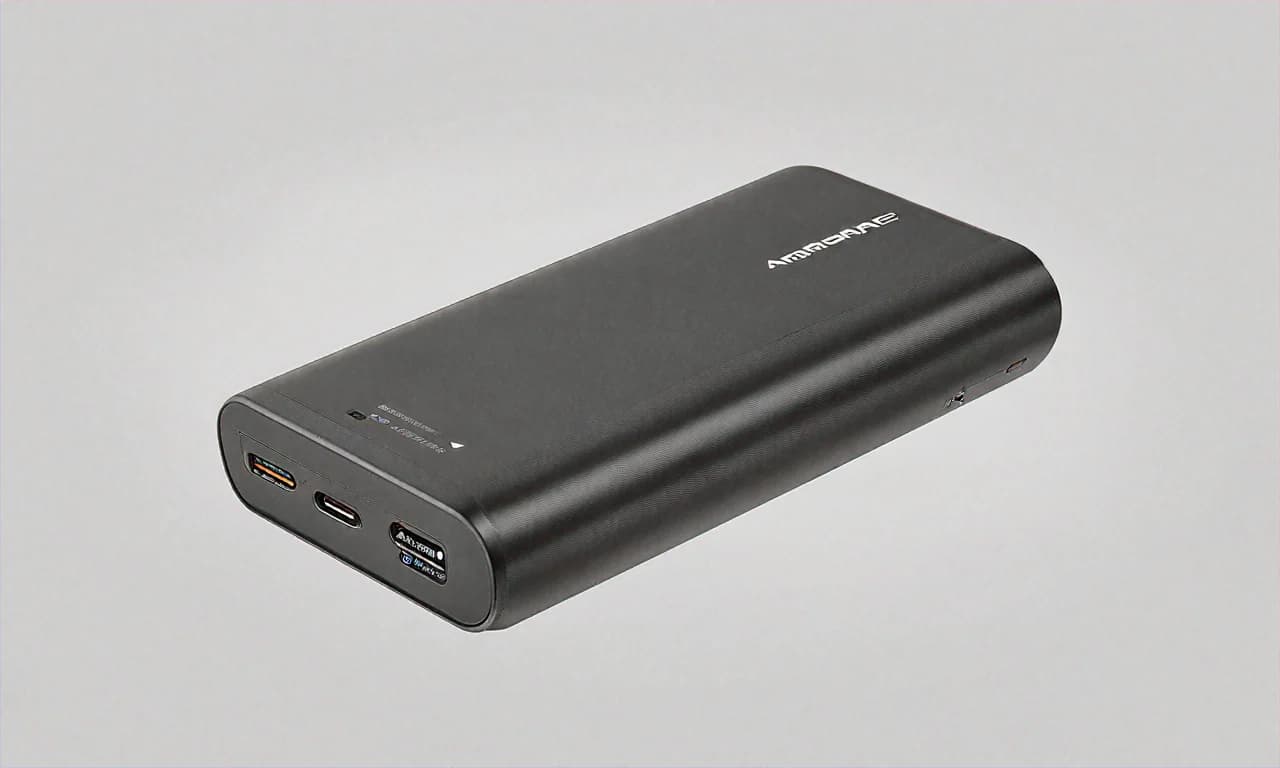
Ambrane 27W 20000mAh Power Bank — How a ₹1,299 Power Bank Became My Daily Driver
There's a weird thing that happens when you review budget tech products. You go in with low expectations. You think "it's ₹1,299, it'll probably be fine, nothing special." And then sometimes a product surprises you. Not in a "oh wow this changed my life" kind of way, but more in a "huh, this actually doesn't suck" way. That's the Ambrane 27W 20000mAh power bank. It doesn't suck. In fact, it's honestly good. And at this price, "truly good" is high praise.
I picked this up on Amazon India during a random Tuesday sale — one of those "Deal of the Day" things where the price drops an extra ₹100 or so. Paid ₹1,299 after the 35% discount from the ₹1,999 MRP. I didn't even use a bank offer on it, which is rare for me. I usually wait for SBI or ICICI card discounts before buying anything on Amazon. But ₹1,299 for a 27W, 20000mAh power bank from a brand I'd heard of? I just added to cart and checked out before the deal expired. Didn't overthink it.
A Quick Word About Ambrane as a Brand
I know some of you are reading "Ambrane" and thinking "never heard of them" or "is this one of those random brands?" Fair enough if you're new to Indian accessories. But Ambrane has actually been around since 2012, and they're a proper Indian company — not a white-label Chinese product with an Indian-sounding name (you know the type). They make power banks, cables, chargers, speakers, and a bunch of other stuff. I've seen their products at Croma, Reliance Digital, and even at those small mobile accessory shops in places like Lajpat Nagar in Delhi and SP Road in Bangalore.
More importantly, they have service centres across India. Not Samsung-level coverage, obviously, but for a Made-in-India accessories brand, it's decent. They have centres in Mumbai, Delhi, Hyderabad, Chennai, Kolkata, and several tier-2 cities. I checked their website and found service centres in Patna, Bhopal, and Guwahati too. So if something goes wrong and you need warranty support, you're not completely stranded. That said, the warranty is only 6 months, which is a bummer. More on that later.
What You Get in the Box
Ambrane keeps the packaging simple. A cardboard box with the power bank, a short Micro-USB cable (not USB-C, which is mildly annoying in 2025), and a warranty card. No charger, no USB-C cable. You'll need to supply your own USB-C cable for fast charging, which most people will have lying around by now. But still, even a basic USB-C cable in the box would have been nice at this price. The Micro-USB cable they include is only useful for the Micro-USB input port — which yes, this power bank still has. A bit old-school, but there are probably still people in India using older chargers with Micro-USB, so I guess it's a backward-compatibility thing.
Build and Design — No Frills, No Complaints
Let me describe this power bank in three words: black plastic rectangle. That's it. There's nothing about the design that will make you stop and admire it. And honestly? Good. I don't need my power bank to be a fashion statement. I need it to charge my phone and not break.
The polycarbonate body has a subtle textured finish that gives it reasonable grip. I've used it with wet hands (monsoon season in Mumbai, you know how it is) and it didn't slip out. The edges are rounded enough that it's comfortable to hold, and there are no sharp seams or rough spots. At 430 grams, it's a tiny bit heavier than the Xiaomi 4i (405g) but you honestly wouldn't notice the difference unless you held them side by side on a kitchen scale.
Four LED indicators show battery level. Press the button, the LEDs light up. Each LED represents roughly 25% charge. Simple. Effective. No complaints. I know some people prefer digital displays that show exact percentage — boAt and URBN offer that — but LEDs are perfectly fine for a budget product. They're visible in daylight and they don't drain any noticeable battery.
Available in Black and Blue. I got Black because... well, because I'm boring and every gadget I own is black. The Blue variant actually looks pretty nice in photos though. If you want something with a bit of personality without going full boAt-neon, the Blue Ambrane is a decent middle ground.
Port Layout — Three Ports Plus Dual Input
This is where Ambrane actually does something smart. You get three output ports — two USB-A and one USB-C. And for input, you get both USB-C (27W) and Micro-USB (18W). That dual input thing matters more than you'd think. Here's why.
I gave my old Micro-USB fast charger to my dad when I switched to USB-C. But when I visit my parents in Lucknow, the only charger available at their house is — you guessed it — Micro-USB. With the Ambrane power bank, I can charge it using their old Micro-USB charger. Sure, it's slower (18W vs 27W), but it works. No need to carry a separate USB-C cable or adapter just for the power bank. This is a practical feature that shows Ambrane understands Indian households where old chargers don't get thrown away, they get repurposed.
The three output ports mean you can charge three devices at once. During Diwali last year, I was at a family gathering in my uncle's flat in Noida and there were like 15 people and maybe 3 working power sockets. My Ambrane power bank became the communal charging station. Had my phone, my cousin's phone, and someone's earbuds all plugged in simultaneously. Did all three charge at maximum speed? Absolutely not. The 27W gets split across ports, probably something like 10W each when all three are in use. But some charge is better than no charge when everyone's phone is dying because they've been taking selfies and making reels all evening.
Charging Speed — 27W is the Sweet Spot for Mid-Range Phones
Let me tell you something that a lot of spec-obsessed tech people miss. The difference between 27W and 33W in real-world usage is... barely noticeable. I'm not saying wattage doesn't matter. Of course it does. But the difference between 27W and 33W translates to maybe 3-5 minutes over a 30-minute charging session. For most people, that's nothing. Especially when the price difference is ₹500 (Ambrane at ₹1,299 vs Xiaomi at ₹1,799).
I tested the Ambrane with several phones over the past few months. Here's what I found:
- Redmi Note 13 Pro (5000mAh): 10% to 50% in about 33 minutes via USB-C. Pretty good.
- Samsung Galaxy A54 (5000mAh): 10% to 50% in about 35 minutes via USB-C. Slightly slower due to Samsung's lower PD acceptance on A-series.
- iPhone 14 (3279mAh): 20% to 60% in about 30 minutes via USB-C to Lightning. Decent, limited by Apple's charging caps more than the power bank.
- OnePlus Nord CE 3 (5000mAh): This one was slower — about 40 minutes for 10% to 50% — because OnePlus uses VOOC/Dash Charge as proprietary protocol, and the Ambrane doesn't support it. Falls back to standard PD at maybe 15-18W.
- Random old Moto G from 2021: Slow. Like 10W slow. But that's the phone's limitation, not the power bank's.
The takeaway? If you have a phone that supports USB PD or QC 3.0 — which covers most mid-range phones sold in India in the last 2-3 years — you'll get good fast charging from this power bank. If you have a phone with proprietary charging (Realme Dart, OnePlus VOOC, Xiaomi HyperCharge), you won't get the maximum speeds but you'll still get decent PD-based fast charging. That's a fair trade-off at ₹1,299.
Battery Life and Real-World Endurance
The 20000mAh capacity gives you roughly the same actual output as any other 20000mAh power bank — about 12000-13000mAh of usable charge at 5V due to voltage conversion losses. In practical terms, that's about 2.5 to 3 full charges for a phone with a 5000mAh battery. Maybe 3.5 charges for something with a smaller battery like an iPhone.
I recently took this power bank on a work trip to Hyderabad. Three-day trip, moderate phone usage — calls, WhatsApp, some Maps navigation, and the usual social media doomscrolling. I charged my phone from the power bank twice over three days (once from 15% to 80%, once from 25% to 90%) and still had about 40% left in the power bank when I got home. That's pretty solid endurance for a ₹1,299 product.
For longer trips — say, a week-long vacation to Goa or Kerala — you'll obviously need to recharge the power bank at some point. But for weekend getaways, two to three-day business trips, or just as a daily backup for heavy phone users, it's more than adequate.
Self-Charging Time — Plan Ahead
Charging the power bank itself from empty to full takes about 4 hours with a 27W USB-C adapter. That's on the slower side compared to premium options — the URBN 65W charges in 2 hours, the Baseus Blade in 1.5 hours — but it's acceptable for a budget power bank. I usually plug it in before bed and it's fully charged by morning.
If you're using a Micro-USB charger for input (the 18W path), expect 5-6 hours for a full charge. And if you're using a really old 5V/1A adapter... maybe 10+ hours. Don't do that unless you have no other option.
Pro tip: invest in a decent 27W or 33W USB-C charger if you don't already have one. Portronics, URBN, and even Ambrane themselves make affordable 25-33W chargers for ₹500-800 on Amazon. It makes a big difference in how quickly you can top up the power bank before heading out.
BIS Certification and Safety
This power bank is BIS certified, which is the Bureau of Indian Standards certification that's technically required for all power banks sold in India. Not all budget brands bother with this — I've seen plenty of uncertified power banks on Amazon from brands with names that look like someone mashed a keyboard. The BIS stamp on the Ambrane gives some assurance that it meets basic safety standards for overcharging, short circuit, and over-temperature protection.
Ambrane claims 9-layer chip protection. I don't know exactly what all 9 layers are — the marketing material is vague — but in practice, the power bank has never gotten uncomfortably hot during use. Warm, yes, especially during 27W output, but never "oh god is this going to explode" hot. I've used it in Hyderabad summer (45°C ambient temperature) and Mumbai monsoon humidity without issues.
The 6-Month Warranty Problem
Here's my biggest criticism of this product. Six months of warranty. That's it. Samsung gives 1 year, boAt gives 1 year, even Anker gives 18 months. Ambrane, at 6 months, is being stingy. Now, in their defence, at ₹1,299, the margins are probably razor-thin and offering a longer warranty would cut into those margins even further. But as a consumer, I want at least a year. Power banks are supposed to last 2-3 years minimum. A 6-month warranty barely covers the initial usage period.
My advice? Buy with Amazon's extended warranty if available (sometimes Amazon offers 1-year or 2-year plans for ₹99-149 on electronics). Or just buy with a credit card that offers purchase protection — HDFC Regalia and SBI Elite cards extend manufacturer warranty by up to a year on electronics purchased with the card. Smart use of credit card benefits can offset the short warranty period.
Ambrane vs Xiaomi vs boAt — The Budget Power Bank Battle
At ₹1,299, the Ambrane's main competitors are the boAt EnergyShroom PB400 (₹1,499) and the Xiaomi Mi Power Bank 4i (₹1,799). Here's my honest comparison:
- If you want the absolute cheapest option that still charges fast: Ambrane wins. ₹1,299 for 27W and 20000mAh is unmatched value.
- If you want the fastest charging under ₹2,000: Xiaomi Mi Power Bank 4i at 33W. You're paying ₹500 more for 6W extra output and Xiaomi's arguably stronger brand name.
- If you want the best-looking option with a digital display: boAt EnergyShroom PB400. Trendy design, LED percentage display, and low-current mode for wearables. But only 22.5W output — the slowest of the three.
- If you want the best warranty: boAt (1 year) beats both Ambrane (6 months) and Xiaomi (6 months).
There's no clear "best" among these three — it depends on what you prioritize. For pure value per rupee, Ambrane wins every time. And that's why it's been my daily driver for the past few months despite having access to pricier options.
Who Should Buy the Ambrane 27W 20000mAh?
College students. People on a budget. Anyone who needs a backup power bank for emergencies and doesn't want to spend ₹2,000+. Daily commuters in Delhi, Mumbai, Bangalore who take the Metro and need their phone alive for Google Pay and QR code tickets. People who already have three power banks and want a cheap one to keep in their car's glove box. Gift-givers looking for a useful Diwali or Rakhi present under ₹1,500.
I'm not going to pretend this is the best power bank ever made. It's not. The build is plasticky, the warranty is short, and 27W isn't the fastest around. But for ₹1,299? Show me a better deal. I'll wait. Actually, I won't, because there isn't one. The Ambrane 27W 20000mAh is the definition of "gets the job done at a price that doesn't make you wince." Stack it with Amazon Pay UPI cashback or SBI card offers during the next sale event and you might even get it under ₹1,200. At that point it's practically an impulse buy, and a surprisingly good one.


