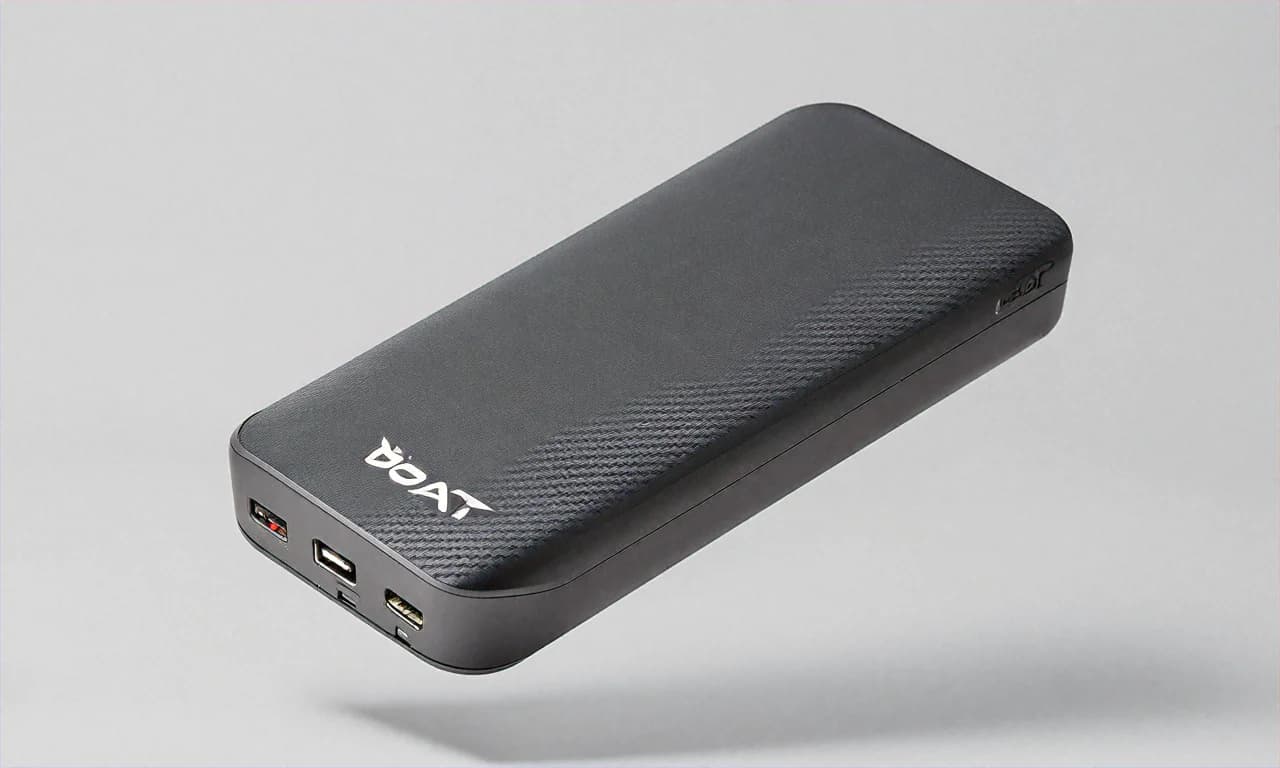
Baseus Blade 100W 20000mAh — The Power Bank That Replaced My Laptop Charger on Trips
I'll be honest with you — when I first saw a power bank claiming 100W output and costing ₹5,499, I thought it was one of those overpromise-underdeliver situations. We've all been there, right? Some random brand on Amazon claims 100W on the listing title, you receive it, test it with a USB power meter, and it barely pushes 18W. Classic move. But the Baseus Blade? It actually delivers. And not just on paper. I've been using it for almost four months now and this thing has truly changed how I travel for work.
Currently priced at ₹5,499 on Amazon India — that's 31% off from the ₹7,999 MRP. Yes, it's expensive for a power bank. I know. You could buy three boAt power banks for this price. But none of those can charge your laptop. And that single fact changes everything about what this product is and who it's for.
Why I Bought a 100W Power Bank in the First Place
So here's the context. I travel between Bangalore and Mumbai roughly twice a month for work. Sometimes Delhi. I work from cafes, airport lounges, trains, and occasionally from those coworking spaces in Indiranagar. My daily carry is a MacBook Air M2, an iPhone 15 Pro, Galaxy Buds, and sometimes an iPad. That's a lot of devices that need charging and not every place I work from has convenient power outlets.
Anyone who has worked from a Starbucks in India knows the outlet situation. There are maybe two outlets in the entire cafe, both occupied by someone who has been sitting there since 8 AM nursing a single tall latte. The Third Wave Coffee outlets are slightly better but still not great. And don't even get me started on airport charging stations — half the outlets don't work and the other half have someone's phone charging with no person in sight.
I used to carry my MacBook's 35W charger everywhere. Thing is, the charger plus cable takes up space, needs an outlet, and if I'm working from a train or bus, it's completely useless. That's when I started looking at high-wattage power banks. After two weeks of research and reading way too many Amazon reviews, I landed on the Baseus Blade.
The Design — Thinner Than You'd Expect. Way Thinner.
The first thing that hits you when you take the Baseus Blade out of its box is how thin it is. 17mm. Let me put that in perspective. Most 10000mAh power banks from brands like Mi and Ambrane are 20-25mm thick. This thing packs 20000mAh into a body that's thinner than power banks with half its capacity. I don't know what kind of battery cell engineering Baseus did here but it's genuinely impressive.
The overall shape is like a slightly oversized smartphone. 153 x 88 mm footprint, so it fits in the laptop sleeve pocket of most backpacks. I carry it in the front organizer pocket of my American Tourister backpack and it slides in right next to my notebook. Doesn't stick out, doesn't create a weird bulge.
Now at 480 grams, it's not light. Let me not pretend otherwise. Half a kilo is noticeable. But consider what you're replacing — a laptop charger (typically 150-200g) plus a cable (50-80g) plus a regular power bank for your phone (250-300g). Combined that's 450-580 grams of stuff. The Baseus Blade replaces all of that. So net weight in your bag actually goes down. I did this math while packing for a Jaipur trip and it clicked. Less stuff, less weight, less tangled cables.
Aluminium Alloy Body — Form Meets Function
The body is aluminium alloy with a matte black finish. It looks and feels like a premium product. More importantly, the aluminium isn't just for aesthetics — it works as a heat sink. When you're pushing 100W of power through a device this size, heat management is actually important. I've had this thing running at full output for 40 minutes straight and while it gets warm, it never gets hot enough to worry about. The heat spreads evenly across the metal surface instead of creating a concentrated hot spot.
There are no squeaky plastic seams, no rattling internal components, no cheap feeling buttons. The power button has a firm click. The ports are aligned properly. Everything about the build screams quality. Coming from someone who has owned power banks where the USB port got loose after three months, this level of build quality matters.
The IPS Display — Finally, Useful Information
Most power banks have these useless four-LED indicators that tell you basically nothing. 25%, 50%, 75%, 100%. Cool. Very helpful. The Baseus Blade has an actual IPS display — small, but sharp and readable — that shows you real-time information. Battery percentage in numbers. Current output wattage. Estimated remaining time. Input wattage when recharging.
The wattage display alone is worth it. When I plug my MacBook Air into it, I can see in real-time that it's pulling 58-62W. When my iPhone is connected, 20-27W depending on the battery level. This kind of transparency is great because you can immediately tell if your device is fast charging or not. No guessing. No "I think it's working?" moments.
The display turns off automatically after about 30 seconds to save power, which is a nice touch. A quick press of the power button brings it back. At night in a dark room the display isn't blindingly bright either — it's well calibrated.
Charging Performance — The Real Test
Laptop Charging — The Main Event
Let's start with the headline feature. I tested the Baseus Blade with my MacBook Air M2, a friend's Dell XPS 13, and another friend's Lenovo ThinkPad X1 Carbon. Results.
MacBook Air M2: pulled 58-65W consistently. Charged from 20% to 80% in about 55 minutes. That is essentially the same speed as the original Apple charger. I was really surprised. From a full 20000mAh charge, I got the MacBook from 10% to about 75% before the power bank ran out. That's roughly 1.5 work sessions worth of backup power — more than enough to survive a power cut or a cafe with no outlets.
Dell XPS 13: similar story. Pulled about 55-60W. Charged at nearly full speed. The XPS 13 has a 52Wh battery so the power bank couldn't fill it completely from empty, but from 30% to 90% was no problem.
The Lenovo ThinkPad was interesting — it's a larger laptop with a 57Wh battery and it was drawing 80-90W from the Baseus. The power bank handled it without throttling for about 30 minutes before stepping down to 65W as the battery heated up. Still very usable. Still much better than no charger at all.
Phone Charging — Not Just an Afterthought
A lot of laptop power banks kind of ignore phone charging. Not the Baseus Blade. Through the USB-C port my iPhone 15 Pro pulled 27W, which is the maximum the iPhone supports. A full charge from 10% to 100% took about an hour and fifteen minutes. Fast by any standard.
My friend tested it with his Samsung Galaxy S24 Ultra and it was pulling 25W via PPS protocol. Not the full 45W the Samsung charger provides, but still solidly fast. For OnePlus users — no, it doesn't support VOOC/Dash/Warp proprietary charging. It will charge your OnePlus phone, but at standard USB PD speeds, not the 80W or 100W that OnePlus's own chargers provide. Something to keep in mind.
The USB-A port is there for legacy devices and maxes out at 18W via Quick Charge. Fine for earbuds, older phones, smartwatches, and such. Not the main attraction but glad it's there.
Simultaneous Charging — Where It Gets Interesting
The Baseus Blade has two USB-C ports and one USB-A port. You can charge three devices simultaneously. But — and this is important — the total power is shared. If you plug in just your laptop, it gets the full 100W. Plug in your laptop and phone together, and the power bank distributes maybe 65W to the laptop and 27W to the phone. All three ports in use? Roughly 45W + 20W + 15W split.
This is standard behavior for multi-port power banks and Baseus is transparent about it in the specs. The display helps here too — you can see the wattage changing in real-time as you connect and disconnect devices.
Self-Charging Speed — This Part Impressed Me
One of the most annoying things about 20000mAh power banks is how long they take to recharge. My old Mi 20000mAh took over 6 hours to fill up from zero. Six. Hours. I would plug it in before sleeping and it would still be at 85% when I woke up.
The Baseus Blade accepts 65W input and goes from 0 to 100% in roughly 1.5 hours. That is absurdly fast for a 20000mAh battery. I usually top it up during my lunch break — plug it in at 1 PM, it's fully charged by 2:30 PM. Even a quick 30-minute charge gives you about 40% which is enough for one laptop emergency charge.
You do need a 65W or higher USB-C charger to get maximum recharging speed. The power bank doesn't come with a charger in the box (standard for this price segment now). If you already have a 65W GaN charger for your laptop, just use that. If not, pick up something like the Anker 735 or Baseus's own 65W GaN charger. Adds another ₹1,500-2,000 to your total investment but you'll use it for your laptop too.
Price and Where to Buy — Let's Talk Money
₹5,499 is the current Amazon price and it's a genuine 31% discount from the ₹7,999 MRP. I've tracked this price for a while and it hovers between ₹5,299 and ₹5,999 depending on the day. During the Amazon Great Indian Festival in October, it dropped to ₹4,799 with additional HDFC credit card offers. During Prime Day last July, similar pricing with ICICI bank card benefits.
If you have an HDFC credit card, watch for those 10% instant discount offers during sale events — that can save you ₹500-550 on this. SBI credit cards occasionally get similar deals. Amazon Pay ICICI gives a steady 5% cashback year-round if you're a Prime member, bringing the effective price to about ₹5,224.
Flipkart lists this too but typically at ₹5,999 or higher. Amazon is the better bet. Also make sure you buy from the "Baseus Official Store" seller on Amazon — there are third-party sellers listing it at slightly lower prices but I wouldn't risk warranty issues for a ₹200 saving.
Is It Worth ₹5,499? My Honest Take.
If you own a USB-C laptop and you travel or work from different locations regularly — yes. Absolutely. The math works out when you think about it. A decent 20000mAh phone power bank costs ₹1,500-2,000. A spare laptop charger costs ₹2,000-3,000. The Baseus Blade replaces both for ₹5,499 while being lighter and more portable than carrying both separately. Plus you get the display, the slim design, and seriously fast recharging.
If you don't own a laptop or you work from a fixed desk every day with outlets available, then no. This is overkill for phone-only charging. Get a ₹1,500 boAt or Ambrane 20000mAh instead.
Airline Compatibility — Yes, You Can Fly With This
I get asked this a lot so let me address it. The Baseus Blade is rated at 74Wh. Indian airlines (IndiGo, Air India, Vistara, SpiceJet, Akasa) allow power banks up to 100Wh in carry-on luggage. International airlines generally follow the same IATA limit. So yes, you're completely fine to carry this on flights. I've taken it on six flights so far — Delhi, Mumbai, Hyderabad, Goa — zero issues at security.
Just remember: power banks must go in carry-on, never checked luggage. And you might get asked to show it at security if they spot it on the X-ray. Just take it out, show them the capacity printed on the back, and you're through in seconds. I keep it in the same tray as my laptop during security screening. Smooth every time.
Four Months In — What I Like and What I Don't
Let me give you the honest rundown after four months of daily use.
The aluminium body has picked up a few micro-scratches from being in my bag alongside keys and other stuff. Doesn't affect functionality but if you're particular about keeping things pristine, use a soft pouch. The charging performance hasn't degraded at all — still pushing the same wattage as day one. The display is still crisp with no dead pixels or dimming. The USB-C ports are still tight with no wobble.
My one actual complaint is that the aluminium gets noticeably cold in winter and warm in summer. Using it at a chai tapri in Delhi during December — the metal body was genuinely cold to hold. In April in Hyderabad, it gets warm just from ambient temperature before you even start charging anything. Not a dealbreaker. Just something to be aware of.
The USB-A port being limited to 18W is fine for what it is. I mostly use it for my Galaxy Buds case which barely pulls 3W anyway. But if someone expected all three ports to do high-speed charging simultaneously, they'd be disappointed.
- Best for: Laptop users who work remotely, travel frequently, or deal with unreliable power supply. Freelancers working from cafes in Koramangala or Hauz Khas. Business travellers doing the Bangalore-Mumbai-Delhi triangle.
- Not for: People who only charge their phone. Budget buyers. Anyone who doesn't own a USB-C laptop.
- Sweet spot: Buy it during an Amazon sale with bank card offers. ₹4,500-4,800 effective price is a steal.
The Baseus Blade 100W sits in my backpack every day now. My laptop charger stays at home on my desk. When I travel for work, I pack one 65W GaN charger and this power bank and I'm sorted for all my devices. That kind of simplicity — fewer cables, fewer chargers, less weight — is exactly what I wanted. Four months in, zero regrets about the purchase. The ₹5,499 has paid for itself multiple times over in convenience alone.