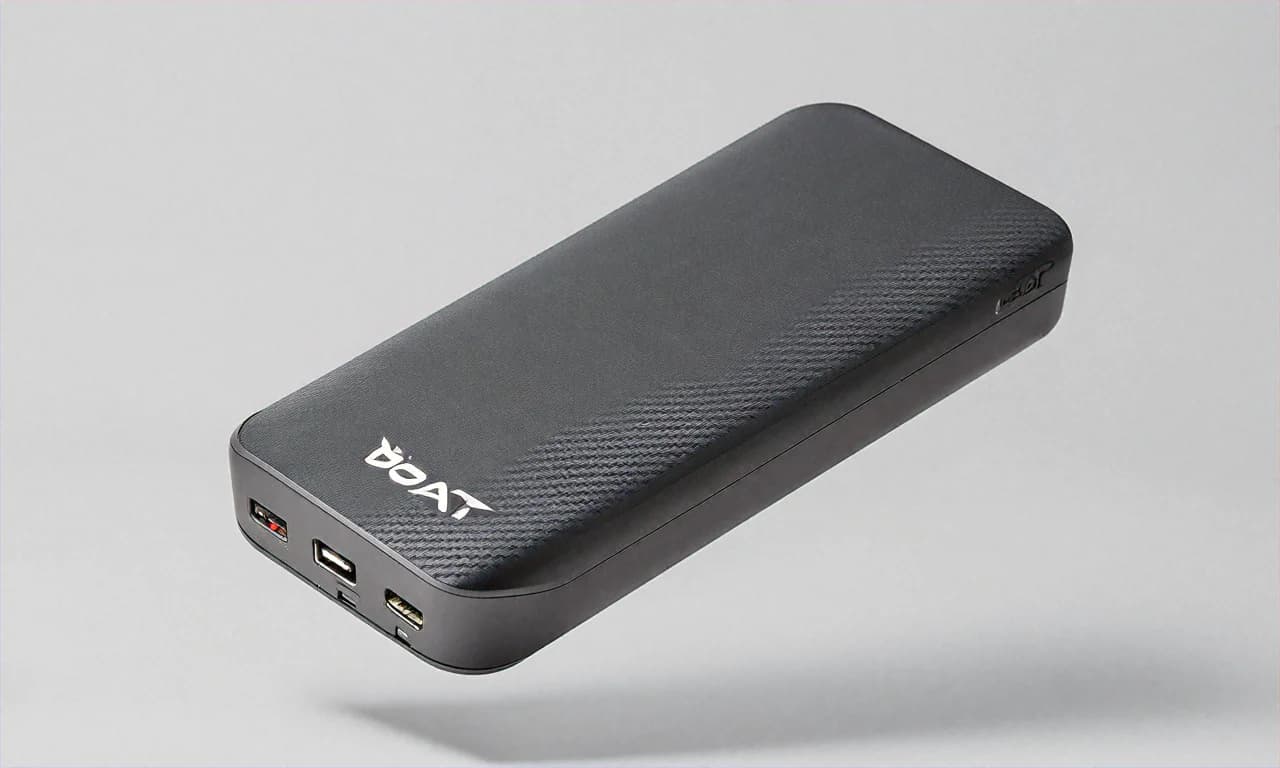
boAt EnergyShroom PB400 20000mAh — Style Over Speed, But Does It Actually Deliver?
boAt is that one brand in India that somehow managed to make accessories cool. I remember when buying a power bank was the most boring shopping decision you could make — you'd just pick whatever the shopkeeper at Nehru Place recommended and move on. boAt changed that. Suddenly you had people showing off their power banks on Instagram. Matching their earbuds to their power bank to their phone case. It's a whole thing now. And the EnergyShroom PB400 is very much part of that trend.
Available at ₹1,499 on Amazon India after a 40% discount from the ₹2,499 MRP, this 20000mAh power bank sits right in the middle of the budget segment — more expensive than the Ambrane at ₹1,299 but cheaper than the Xiaomi 4i at ₹1,799. The question I had before buying it was simple: is boAt selling me a good power bank, or just a good-looking power bank? After two months of daily use, I have thoughts. Many thoughts.
The boAt Tax — Are You Paying for the Brand?
Let me get this out of the way first. There is absolutely a "boAt tax" on this product. At 22.5W maximum output, this is the slowest fast-charging power bank in its price range. Ambrane gives you 27W at ₹1,299 (₹200 less). Xiaomi gives you 33W at ₹1,799 (₹300 more but significantly faster). boAt gives you 22.5W at ₹1,499 and a nicer design. You're paying for the brand, the aesthetics, and the digital display. Whether that's worth it depends entirely on your priorities.
I'll be honest — when I first saw the 22.5W spec, I almost didn't buy it. I was at my friend Rohan's flat in Indiranagar, Bangalore, and he had the Sage Green variant sitting on his desk. It looked really nice. Like, surprisingly nice for a ₹1,499 product. He let me try it, and the digital display showing exact battery percentage won me over. I'm a sucker for precise numbers. Those four vague LED dots on other power banks drive me slightly crazy. Is it at 60%? 75%? Who knows? The boAt display tells you exactly. 67%. Done. No guessing.
So I ordered the Carbon Black variant on Amazon that night, with an HDFC credit card 10% instant discount bringing the price to about ₹1,350. During Amazon's Great Republic Day Sale in January, I've seen it go even lower with Amazon Pay ICICI card cashback stacking on top. If you're patient, ₹1,200-1,300 effective price is very achievable.
Unboxing and That First Impression
boAt does packaging well. Better than most brands at this price. The box has their branding, some attitude-filled copy about being a "boAthead" (their term for fans, which I find endearing and a little cringe at the same time), and inside you get the power bank, a USB-A to USB-C cable, and a user manual. No charger, which is expected. The cable quality is okay — it's a braided cable which is nice, but it's pretty short. Maybe 30cm. Useful for connecting the power bank to your phone while holding both, but not for much else. I ended up using my own 1-metre cable instead.
First touch, the rubberised polycarbonate body feels actually pleasant. It's not that cheap smooth plastic feel you get on budget products. There's a slight softness to it, almost like a matte silicone phone case. It grips well in the hand, doesn't slip on surfaces, and the texture hides minor scratches effectively. I've been carrying it in the same bag pocket as my keys for two months and there are no visible marks.
The Carbon Black isn't a plain black — it has a subtle pattern, almost like a very fine carbon fibre weave, that catches light at certain angles. It's a small detail but it adds to the premium feel. The Sage Green and Midnight Blue variants are even bolder. My friend's Sage Green one gets compliments regularly. If aesthetics matter to you (and for boAt's target audience, they definitely do), this is probably the best-looking power bank under ₹2,000 in India.
The Digital Display — My Favourite Feature
I keep coming back to this because it legitimately changes how I use the power bank. The LED digital display sits on the front face and shows the battery percentage as a two-digit or three-digit number (like "87" or "100"). When you plug in a device, it shows the percentage depleting in real-time. When you charge the power bank, it shows the percentage climbing. It's simple. It's useful. And I don't understand why every power bank doesn't have this.
The display is white LED on a black background. Visibility is good in indoor lighting and okay in direct sunlight — you might need to shade it with your hand if you're checking at the beach in Goa, but it's readable. The display auto-turns off after about 30 seconds of inactivity to save battery, which is a sensible choice. Press the power button and it lights up again.
I've compared the accuracy of the percentage reading against what my phone reports as charging input, and it seems reasonably accurate. When the display says 50%, I get roughly half the expected total charges out of it. No complaints there. Some cheaper power banks with digital displays have famously inaccurate readings — showing 30% when they're actually almost dead — but the boAt PB400 seems calibrated properly.
Charging Speed — The Honest Truth About 22.5W
Okay here's where I have to be honest and not just fanboy over the design. 22.5W is fine. It's not fast by 2025 standards. It's more like... "fast enough." Let me put some numbers behind that statement because vague opinions help nobody.
I tested the PB400 with these phones over the last two months:
- Samsung Galaxy A54 (5000mAh, supports 25W PD): From 10% to 50% in about 38 minutes. That's noticeably slower than the same test on the Xiaomi 4i (about 30 minutes). The difference is most apparent in the 10-40% range where fast charging protocols hit peak speeds. The boAt just doesn't push as many watts into the phone during this window.
- iPhone 14 (3279mAh, via USB-C to Lightning): From 20% to 60% in about 28 minutes. Actually pretty good here, because iPhones cap at about 20W from power banks anyway. The boAt's 22.5W is close enough to Apple's maximum that you don't really lose anything compared to faster power banks.
- Redmi Note 12 Pro (5000mAh, supports 67W wired but USB PD at ~18W): From 15% to 55% in about 40 minutes. Decent, not amazing. Redmi phones that support proprietary fast charging don't get those speeds from third-party power banks regardless, so this is a limitation of the phone's PD acceptance, not just the power bank.
- Nothing Phone 2 (4700mAh, supports 45W wired): From 10% to 50% in about 35 minutes via USB-C PD. The Phone 2 accepts PD well and the boAt's 22.5W was fully used here.
The bottom line: if you're someone who obsesses over charging speeds and times everything with a stopwatch, the boAt PB400 will frustrate you. Get the Xiaomi 4i instead. But if you're a normal human who plugs in their phone, puts it aside, and checks back in 30-40 minutes, the boAt's speed is perfectly adequate for daily use. You're not going to be sitting there thinking "man, I wish this was 10W faster." At least I don't.
Low-Current Mode — The Hidden Gem
This feature alone might justify the boAt over some competitors. Double-press the power button and the PB400 enters low-current mode, reducing output to around 2.5W. Why would you want less power? Because TWS earbuds, smartwatches, and fitness bands have tiny batteries that can get damaged by regular charging wattage.
I charge my boAt Airdopes 141 (yes, I'm a full boAt person now, judge me) from this power bank regularly. In normal mode, the earbuds would charge super fast but the power bank would cut off after a few minutes because the current draw was too low for it to detect an active device. Happens with most power banks — they think nothing is connected and shut off. Low-current mode fixes this completely. The power bank stays on and delivers a gentle trickle charge until the earbuds are full.
I also use it to charge my Noise ColorFit Pro 4 smartwatch. Same deal — low-current mode keeps the connection active and charges the watch slowly and safely. If you own any wearables (and most people in India now own at least TWS earbuds), this feature is genuinely useful and not just a marketing gimmick.
Build Durability — Two Months In
I've been carrying the PB400 in my laptop bag's side pocket daily for two months. It shares the pocket with a USB cable, sometimes my wallet, and occasionally random stuff like metro cards and candy wrappers. The rubberised surface has held up well — no peeling, no major scratches, no discolouration. There's a tiny scuff near the USB-C port where I occasionally miss the plug-in on the first try (happens in the dark), but it's barely visible.
I dropped it once on the floor of a co-working space in Koramangala. Concrete floor, about 3-foot drop from a desk. The power bank bounced (the rubberised surface is slightly shock-absorbent), and I picked it up expecting the worst. Nothing. No cracks, no display damage, no rattling sounds. Turned it on, display showed 73%, everything working normally. For a ₹1,499 product, that's reassuring.
One thing I have noticed, though — the rubberised surface does attract lint and dust. If you keep it in a jean pocket, you'll notice fuzz sticking to it. It wipes off easily, but it's a minor annoyance that smooth plastic or metal power banks don't have. Not a dealbreaker, just something to be aware of if you're the type who likes keeping your gadgets spotless.
Battery Life and Endurance
The 20000mAh capacity delivers the same real-world usable charge as any other 20000mAh power bank — roughly 12000-13000mAh at output voltage after conversion losses. That translates to about 2.5 full charges for a 5000mAh phone or 3+ charges for smaller-battery phones like iPhones.
I took this to a wedding in Jaipur last month. Four days of functions, ceremonies, and everyone taking photos and videos non-stop. I charged my Samsung A54 from the power bank once each day (usually from 20% to 85%) and the power bank lasted the full four days on a single charge. Started at 100% on day one, ended at about 15% on day four evening. Perfect timing — I charged it that night at the hotel and it was ready for the return trip.
For daily commute use, if you're only topping up your phone once a day, this power bank will easily last a full work week without needing a recharge. My usage pattern is charge the phone from about 30% to 80% during my evening commute (Indiranagar to Whitefield, Bangalore — if you know, you know, it's a long ride), and the power bank lasts 4-5 such sessions.
Self-Charging Speed
The PB400 accepts up to 20W input via USB-C and up to 12W via Micro-USB. With a 20W USB-C charger, a full charge from empty takes about 4.5 hours. That's slower than the Xiaomi 4i (3 hours at 33W input) and significantly slower than premium options. With the Micro-USB input, you're looking at 7+ hours. Not ideal.
I charge mine overnight, so the exact self-charging time doesn't bother me in practice. But if you need a quick top-up before heading out — say, you forgot to charge it last night and you have a flight from Delhi in 4 hours — you're not going to get a full charge in time. Plan ahead. Set a Sunday night reminder on your phone to plug in the power bank, and you'll never have this problem.
Warranty and After-Sales
boAt offers a 1-year warranty on the PB400, which is better than both Xiaomi (6 months) and Ambrane (6 months) for their similarly priced power banks. boAt's warranty process is mostly online — you register on their website, raise a ticket, and they arrange pickup or ask you to ship the product to their service centre. I haven't had to use it personally, but I've read mixed reviews online. Some people say the process is smooth, others say it takes 2-3 weeks. Typical for online-first brands in India.
The 1-year warranty is a genuine differentiator in this price segment. If warranty coverage is important to you (and it should be), the boAt PB400 has an edge over Xiaomi and Ambrane. It's not Samsung or Anker-level after-sales, but for ₹1,499, it's the best warranty you'll find.
Colour Options and the "Show-Off" Factor
Let me spend a moment on the colour options because, for boAt's target audience, this matters.
- Carbon Black: The safe choice. Understated, professional, goes with everything. This is what I got. No regrets but also no wow factor.
- Sage Green: The bold choice. This is the one you see in boAt's marketing and Instagram ads. Looks fantastic in person. If you want people to notice your power bank (which sounds weird but boAt has somehow made it a thing), get this one.
- Midnight Blue: The in-between. Darker than you'd expect, almost navy. Looks good but doesn't pop as much as the Sage Green.
If you're buying this as a gift — and with Diwali, Rakhi, birthday season, whatever — the Sage Green in a nice gift bag would impress someone who's into tech accessories. It's one of those ₹1,499 gifts that looks like it costs more. Practical gift-giving hack right there.
Final Thoughts — Who Should Buy This and Who Shouldn't?
Buy the boAt EnergyShroom PB400 if you want a power bank that looks good, has a digital display, offers low-current mode for your earbuds and smartwatch, and comes with a 1-year warranty. It's the most feature-rich option under ₹1,500 in India, and the design is really a class above anything else at this price.
Don't buy it if charging speed is your top priority. At 22.5W, it's the slowest "fast charging" power bank in its segment. The Xiaomi 4i at 33W or even the Ambrane at 27W will charge your phone faster. If speed matters more than style, look at those instead.
Also don't buy it if you hate the boAt aesthetic. Some people find boAt's marketing and branding a bit try-hard. If you're one of those people, a plain Xiaomi or Samsung power bank might suit your personality better. There's no right or wrong here — it's personal preference.
For me, the PB400 has been a reliable daily companion that I enjoy using. The display, the low-current mode, the texture of the body, even the little boAt logo on the back — it all adds up to a product that feels considered and intentional, not just another black rectangle with ports. At ₹1,499 on Amazon, especially with HDFC or Amazon Pay ICICI card cashback during sales, it's a solid purchase that I'd recommend to anyone who asks. And trust me, after seeing the Sage Green variant, plenty of people do ask.


