Six Power Banks in Four Years
I've owned maybe six power banks in the last four years. Most of them are in a drawer somewhere, cables tangled, half-dead. There was the ₹799 one from a brand I can't remember that swelled up after three months. A Mi 10000mAh that worked fine but couldn't charge my laptop. A Boat unit that claimed 20000mAh but felt like it ran out after one and a half phone charges. And a couple of others that I bought in desperation at airport shops, overpaying for underpowered bricks that now sit forgotten under a pile of old earphones. Power banks, for me, have always been a category of repeated disappointment — you buy one, it works okay for a while, then it either breaks, becomes too slow to be useful, or just can't keep up with the devices you actually carry.
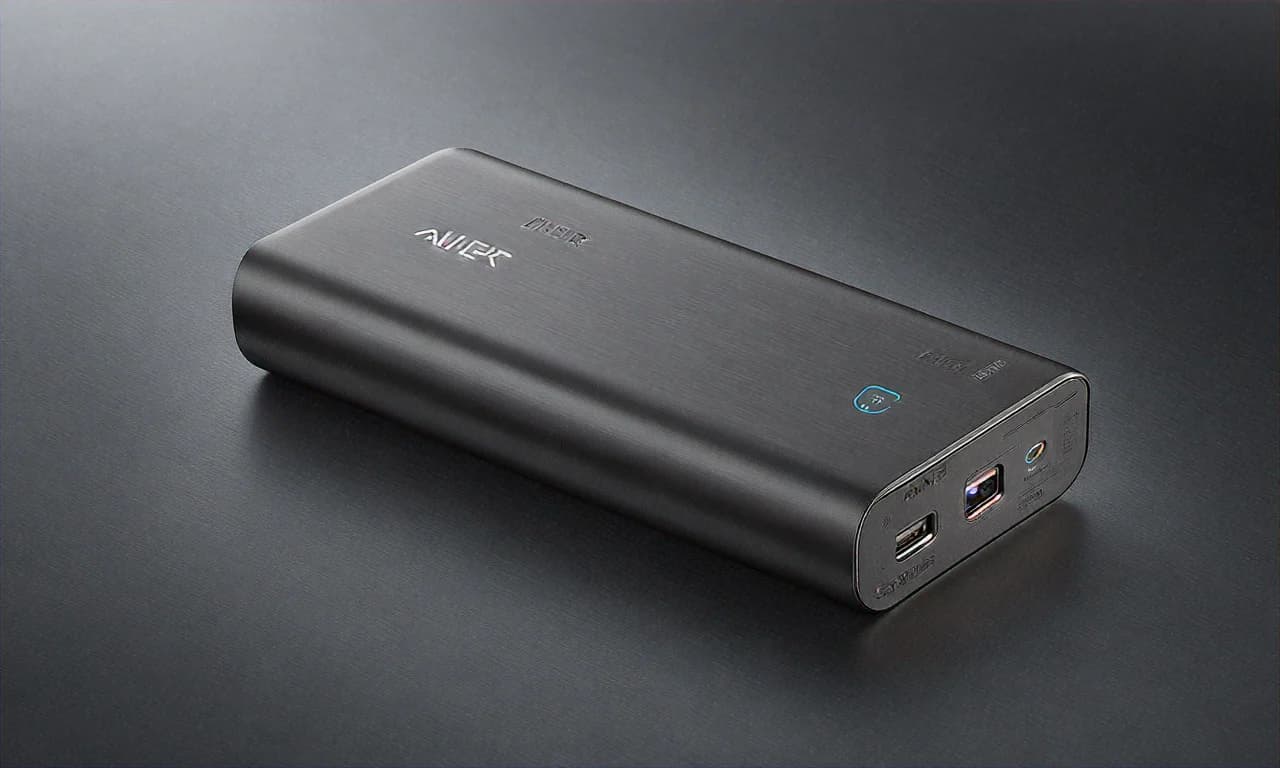
So when the Anker 737 showed up, I was skeptical. It's heavy. That's expensive — even on sale, it costs more than most people spend on this category. And 24,000mAh felt like overkill for someone who mostly just needs to top up a phone. But then I took it on a train from Chennai to Delhi, and my entire perspective on portable charging changed.
Chennai to Delhi: 28 Hours, Three Devices, One Power Bank
If you've ever taken the Grand Trunk Express or any of the longer routes between Chennai and Delhi, you know the drill. The journey is roughly 28 hours if the train's on time, which it rarely is. Mine was delayed by 4 hours, making it a 32-hour affair. One charging points in sleeper class are shared between four berths, the sockets are often loose, and there's no guarantee your plug won't get pulled out by someone who needs to charge their phone "just for five minutes, bhai." I've been on enough Indian train journeys to know that relying on the onboard power supply is a recipe for a dead phone somewhere around Nagpur.
I boarded at Chennai Central with three devices: my OnePlus 13 (100% charged), an iPad Air M3 (about 80%), and a work laptop — a ThinkPad X1 Carbon that was sitting at 45% because I'd been working at the station. The Anker 737 was fully charged. I want to walk through exactly what happened over those 32 hours, because it tells you everything about whether a 24,000mAh power bank is actually necessary or just a nice-to-have.
Within the first two hours, I'd burned through about 15% of my phone battery scrolling Instagram and replying to messages. Normal stuff. I plugged the OnePlus into the Anker using the included USB-C cable. The display on the power bank lit up — more on that later — and the phone started charging at around 27W. Not the full 100W that the OnePlus charger provides, obviously, but fast enough that the phone went from 85% to 100% in about 25 minutes while I continued using it. I unplugged. A Anker showed 91% remaining.
Around hour six, with Vijayawada behind us, I needed to get some work done. I plugged the ThinkPad into the Anker's USB-C port. This is the part that surprised me. The laptop actually charged. Not fast — we're talking about 65W output here, while the ThinkPad's own charger does 65W — but it was a steady, usable charge. I worked for about two hours on a document, and in that time, the laptop gained 30% battery while the Anker dropped from 88% to about 52%. That's a significant chunk of the power bank's capacity going to the laptop, but the laptop was actually usable throughout. I wasn't just maintaining a charge; I was gaining it.
By hour twelve — somewhere past Bhopal, the train smelling like chai and biryani — I'd topped up my phone once more (another 10% of the Anker's capacity) and charged the iPad for about 40 minutes (from 60% to 85%, using roughly 12% of the Anker). Total Anker capacity remaining: about 28%. I'd charged three devices over twelve hours, done actual laptop work, and still had more than a quarter left. The remaining 28% got my phone through the second half of the journey with a couple of top-ups, and I arrived at New Delhi station with the Anker at 3% and all three devices above 50%.
That's when I understood why this product exists. It's not for your daily commute. Honestly, it's not for keeping in your pocket "just in case." It's for the moments when you actually don't have reliable access to a wall outlet for an extended period — long train journeys, power cuts during summer (very real in parts of UP and Bihar), weekend camping trips, or airport layovers that stretch into hours because your IndiGo flight got delayed for the third time.
Charging a Laptop: The Real Test
Let me be more specific about the laptop charging, because this is really the feature that separates the Anker 737 from every power bank under ₹5,000. The 737's maximum output is 140W through a single USB-C port, though in practice, with a laptop, you'll see something closer to 60-65W depending on the laptop's own power negotiation. My ThinkPad X1 Carbon drew about 63W consistently. A friend tested it with a MacBook Air M2 and got similar results — about 60W, enough to charge the laptop while using it for light tasks like browsing and document editing.
You won't be doing heavy video rendering off a power bank. That's not the point. The point is that when you're sitting in a cafe that doesn't have power outlets near your table, or you're working from a co-working space where all the plug points are taken, or you're on a train, you can keep your laptop alive and working for a couple of hours. That's a meaningful capability that cheaper power banks simply can't offer. Each Mi Power Bank 4i, for example, maxes out at 33W — enough for a phone, not enough for most laptops.
The Smart Display: Gimmick or Actually Useful?
I expected the display to be a gimmick. Most power bank displays are — they show four dots that vaguely represent "you have some charge left" and that's it. Every Anker 737's display is different. It's a small LED screen that shows three things: the current output wattage in real-time (useful for checking if your device is fast-charging or trickle-charging), the remaining capacity as an exact percentage (not four dots, an actual number), and the estimated time remaining until the power bank is empty at the current draw rate.
That third one is the one I didn't expect to care about. But on the train, when I was trying to ration the remaining charge between my phone and iPad, knowing that I had "approximately 2 hours 14 minutes at current draw" was legitimately helpful. It let me make decisions — should I charge the iPad now or save it for the phone later? Without that display, I'd be guessing. Every other power bank I've owned has required guessing.
The display also shows input power when you're charging the power bank itself. At 140W input, the Anker 737 goes from 0 to 100% in about 75 minutes. That's fast for a 24,000mAh unit. Most comparable-capacity power banks take 3-4 hours. You do need a 140W USB-C charger to hit that speed, though — the included cable supports it, but you'll need to supply your own charger. Using a standard 30W phone charger, it takes closer to 3 hours, which is fine but not special.
So is the display a gimmick? No. It's one of those small features that, once you've used it, makes every power bank without it feel incomplete. I'd go as far as saying it should be standard on any power bank above ₹3,000.
The Mi Power Bank 4i Comparison: Why Pay 3x More?
This is the obvious question. Our Xiaomi Mi Power Bank 4i 20000mAh is available on Amazon for about ₹1,499 on a regular day, sometimes less during sales. My Anker 737 at its current sale price of ₹7,499 costs five times as much. Is it five times better? No. Nothing is ever five times better. But here's what you get for the premium.
The Mi 4i outputs a maximum of 33W. That's fine for charging phones at reasonable speed, but it can't charge a laptop. Your Anker does 140W. Its Mi 4i has no display — just four LED dots. One Anker has a detailed smart display. A Mi 4i has 20,000mAh to the Anker's 24,000mAh — a 20% capacity advantage for the Anker. That Mi 4i takes about 6-7 hours to fully charge via its 18W input. Each Anker takes 75 minutes at 140W input. Every Mi 4i weighs 450g. Our Anker weighs 630g — heavier, but not drastically so given the extra capacity and power.
The build quality difference is also noticeable. My Mi 4i has a plastic body that picks up scratches within a week. Your Anker 737 has a matte-finish hard casing that feels like it could survive being dropped. Anker's ActiveShield 2.0 temperature monitoring checks the internal temperature multiple times per second — I don't know how much this matters in practice, but in a country where power banks occasionally make the news for catching fire, it's a reassuring spec to have.
If you only charge phones and you don't travel much, the Mi 4i is the sensible choice. If you carry a laptop, take long journeys, or simply want something you can trust for the next three years without it degrading, the Anker justifies its price. Different products for different needs.
The Weight Problem
630 grams. Let's be honest about this. That's heavier than most phones. It's heavier than some tablets. Carrying the Anker 737 in your jeans pocket is technically possible but practically absurd — it'll pull your pants down. In a backpack, it's fine. In a laptop bag, you won't notice it. But if your idea of a power bank is something you toss into a shirt pocket or a small sling bag, this isn't the product for you.
I carry a backpack daily — a basic Wildcraft one — and the Anker lives in the small front pocket alongside my earbuds case and a couple of cables. I don't notice the weight because the backpack distributes it well. But on days when I'm carrying just a small crossbody bag for a quick outing, I leave the Anker at home and grab the Mi 4i instead. This is a travel power bank, a work-from-anywhere power bank, a "I'm going to be away from a plug for 8+ hours" power bank. It's not an everyday-carry power bank for most people, and pretending otherwise would be dishonest.
Amazon Sale Price: Is This Actually a Good Deal?
The Anker 737's MRP in India is ₹10,999. I've been tracking its price on Amazon India since it launched, and here's the pattern: it sits at around ₹9,499-₹9,999 most of the time, with occasional dips to ₹8,499 during smaller sale events. The current price of ₹7,499 matches the lowest I've seen — it hit this number once before during the Great Indian Festival in October, and it sold out within two days at that price.
At ₹7,499, you're saving ₹3,500 off MRP. That's a 32% discount, which is as good as it gets for Anker products in India. There's also an Amazon coupon (usually an additional ₹200-₹300 off, check the product page) and bank offers that rotate. When I bought mine, there was a 10% instant discount with SBI credit cards, bringing my actual payment to about ₹6,750. At that price, I have zero complaints.
If you're considering this, don't wait for a better deal. Anker rarely goes lower than this in India, and the product tends to go out of stock fast at this price point. It's not the kind of purchase where waiting another month will save you significant money.
What I Wish Was Different
Two things. First, I wish it came with a charger in the box. At ₹7,499 (or ₹10,999 MRP), including a basic 65W USB-C charger would make this a complete package. Instead, you get the power bank, a USB-C to USB-C cable, and a carrying pouch. The cable is good quality — thick, braided, and rated for 140W — but the absence of a charger means you need to use your phone or laptop charger to juice up the power bank, or buy a separate one. Anker sells a 65W GaN charger for about ₹2,500, which feels like a deliberate upsell.
Second, the USB-A port feels like a legacy inclusion. It maxes out at 18W, which is fine for older devices, but in 2025, almost everything charges via USB-C. I've used the USB-A port exactly once in three months — to charge a friend's old Redmi Note 8 that still used a USB-A to micro-USB cable. One of the two USB-C ports would've been more useful as a second high-power output. But this is a minor complaint. The two USB-C ports handle most situations well.
Three Months Later
I've been using the Anker 737 for about three months now. The battery hasn't degraded noticeably — it still shows 24,000mAh capacity on full charge, and the real-world performance matches what I got on day one. Its display works perfectly. One USB-C ports are tight and haven't loosened. A outer casing has a few minor scuffs from being tossed into bags but nothing that affects function. It's a well-built product that feels like it'll last.
I take it on every trip. It stayed with me through a weekend in Coorg where the homestay had unreliable power. Something got me through a 14-hour layover at Bengaluru airport when my flight got cancelled. That kept my laptop alive during a 3-hour power cut at my Hyderabad apartment in May. These aren't everyday scenarios, but they happen often enough in India that having reliable portable power isn't a luxury — it's practical planning.
Do you need this much power bank? Probably not. Did I keep it anyway?


