Mi Power Bank 4i 20000mAh 33W — Is This Really the Best Budget Power Bank in India?
Okay so let me just say this upfront. I have been using Xiaomi power banks since the days of the original 10000mAh model — that silver brick that literally every engineering student in my Pune college had. Some things have changed since then, some haven't. The price-to-performance ratio? Still absurdly good. The build material? Still plastic on the budget models. The feeling of relief when your phone dies at a railway station and you remember the power bank in your bag? Priceless, as always.
The Mi Power Bank 4i 20000mAh with 33W fast charging is currently going for ₹1,799 on Amazon India, which is a straight 28% drop from the ₹2,499 MRP. Now, I know what some of you are thinking — "bhai, ₹1,799 is still a lot for a power bank." But hear me out. At this price point, you're getting 33W output, 20000mAh capacity, and triple ports. That combination simply doesn't exist anywhere else unless you go for some no-name brand from Nehru Place that will probably stop working in two months.
Why I Picked This Up in the First Place
So here's some context. I was travelling from Mumbai to Goa last November — by road, not flight — and my Samsung A54 died literally 3 hours into the trip. I had one of those cheap ₹500 power banks from a local shop near Dadar station and that thing was giving me maybe 5W output. My phone was charging slower than it was draining while I used Google Maps. Frustrating doesn't even begin to cover it. After that trip, I decided I needed a proper power bank that could actually fast charge my phone on the go, without spending what I'd spend on a meal at a decent restaurant.
The Mi Power Bank 4i popped up during the Amazon Great Indian Festival in October, and with the SBI credit card 10% instant discount, I ended up paying something like ₹1,620 effective. Not bad at all. HDFC card users also had a similar offer running at the time, and I've seen ICICI Amazon Pay card cashback stack on top of the sale price too. So if you're patient and wait for the next sale event — Republic Day sale is usually good for accessories — you can get this for even less.
Build Quality — Plasticky but Practical
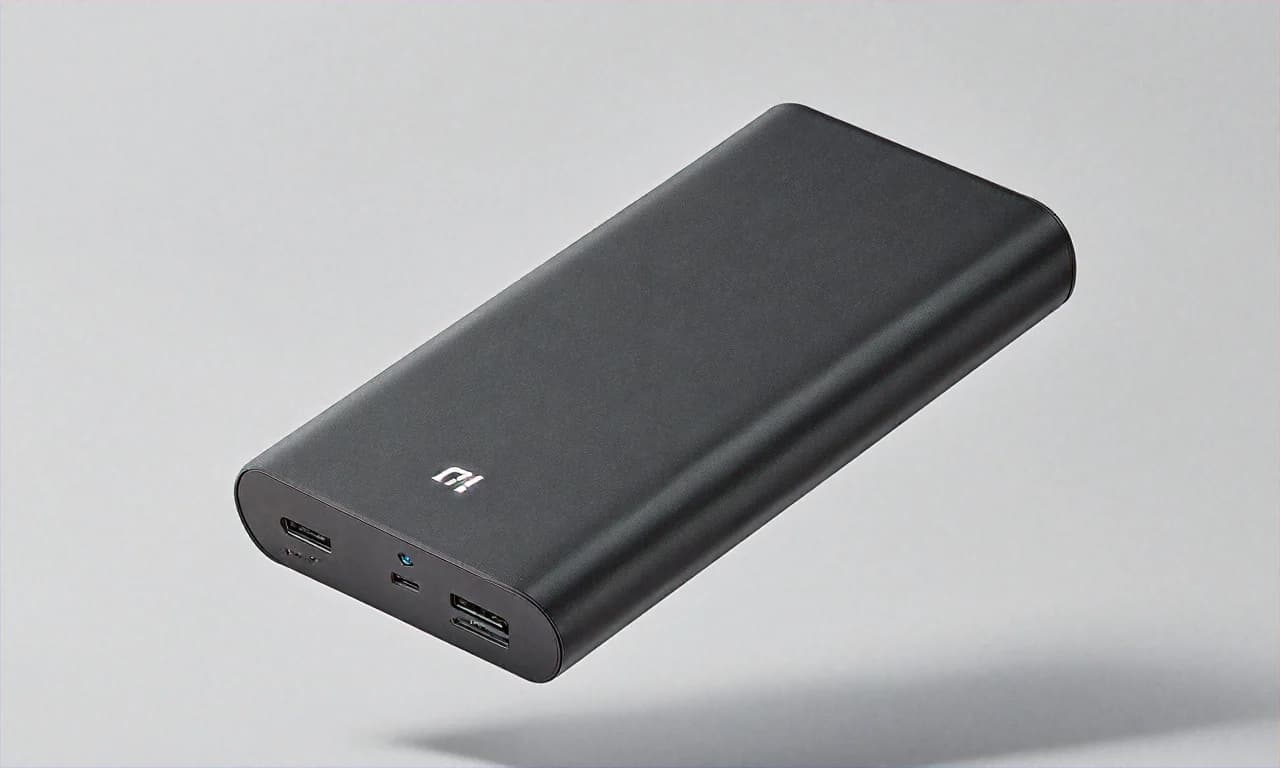
Let me be honest here. This is not a power bank that will make your friends go "wow, that looks premium." It is a polycarbonate body with a matte finish. It's functional. It does the job. The texture doesn't collect fingerprints too badly which is nice, and I haven't noticed any scratches even after tossing it into my bag with keys and earphones for the last few months. But if you put it next to a Samsung or Anker metal-body power bank, the difference in feel is obvious.
That said, there's something to be said for plastic bodies on power banks. They're lighter. This thing weighs about 405 grams, which for a 20000mAh unit is pretty reasonable. I carry it in my jeans pocket sometimes — not ideal, it does bulge — but it's doable for short walks. Compare that to some of the metal body options that push 500g+ and you'll appreciate the weight savings when you're lugging it around during your Bangalore to Mysore weekend trip.
The four LED indicators on the side are basic but they work. You press the button, they light up, you get a rough idea of how much charge is left. 25%, 50%, 75%, full. Nothing fancy like a digital percentage display, but for ₹1,799, I am not going to complain about that. The LEDs are white and fairly visible even in bright sunlight, which is something I've actually noticed. Some power banks have such dim indicators that you can't tell the charge level unless you're indoors.
Port Layout and Cable Situation
You get two USB-A ports and one USB-C port along the short edge of the power bank. The USB-C port handles both input and output, which means you use the same port to charge the power bank and to charge your phone. I wish they had included a separate dedicated input port, because sometimes I want to charge the power bank and use it to charge another device at the same time. You can do pass-through charging, but the speeds drop noticeably.
One thing that mildly annoys me — Xiaomi doesn't include a cable in the box. You get the power bank and a user manual. That's it. Now I understand they're keeping costs down, but even a basic USB-A to USB-C cable would have been a nice touch. If you don't already have a USB-C cable lying around (which, let's be real, most of us do at this point), you'll need to buy one separately. You can grab a decent Amazon Basics cable for ₹200-300. Not a dealbreaker but worth mentioning.
Charging Speed — The 33W Promise and the Reality
Here's where it gets interesting. The 33W output sounds great on paper, and to be fair, it delivers when the conditions are right. I tested it with my Redmi Note 13 Pro (which supports Xiaomi's proprietary fast charging) and it went from about 10% to 55% in roughly 30 minutes. That's legitimately impressive for a power bank this cheap. My wife's Samsung Galaxy A34, which supports 25W charging, got to about 45% from dead in the same timeframe via the USB-C port with PD protocol. Not mind-blowing but definitely faster than those old 10W power banks.
Now here's the catch. That 33W output is the maximum across all ports. If you plug in two or three devices simultaneously — which you can, there are three ports — the wattage gets split. I tried charging my Redmi, a friend's iPhone 14, and my TWS earbuds all at once, and the charging speed on the phone dropped to what felt like regular 10-15W speeds. Still usable, but don't expect 33W on all three devices at the same time. The laws of physics apply even to Xiaomi products.
For iPhone users specifically — yes, it works with iPhones. The USB-C port puts out USB PD, so you'll get around 20W charging on an iPhone 15 or later. For older Lightning iPhones, you'll need a USB-A to Lightning cable and you'll be limited to Apple's standard speeds. Not really the power bank's fault, that's just how Apple does things.
How Long Does the 20000mAh Actually Last?
This is the question everyone asks, and the answer is... it depends. The rated capacity is 20000mAh at 3.7V, but the usable output at 5V is lower due to energy conversion losses. In my experience, I get about 3.5 full charges on my Redmi Note 13 Pro (which has a 5000mAh battery) before the power bank dies. That's roughly 70-75% efficiency, which is standard for Li-polymer batteries at this price.
For context, that means on a two-day trip — say, Delhi to Jaipur and back — this power bank comfortably keeps my phone alive for the entire duration with moderate use. I've also used it during 12-hour train journeys (the Rajdhani from Delhi to Mumbai, if you're curious) and it handled my phone, my wife's phone, and still had some juice left for the auto ride from the station to home. Very reassuring.
One pro tip — avoid using the power bank in extreme heat. I made the mistake of leaving it on the dashboard of my car during a Chennai summer trip and the thing got alarmingly hot. It didn't malfunction, credit to Xiaomi's 12-layer chip protection, but the charging speed dropped significantly and the battery level seemed to drain faster. Keep it in your bag, in the shade. Basic stuff but worth saying.
Self-Charging Time
If you plug the Mi Power Bank 4i into a 33W charger (sold separately, obviously), it takes about 3 hours to go from empty to full. That's... acceptable. Not amazing. The Baseus Blade, for comparison, does it in 1.5 hours, but that also costs three times as much. If you use a standard 10W charger — like the one that came with your old Redmi — prepare to wait 7-8 hours. Overnight charging is the way to go if you don't have a fast charger.
Personally, I charge it every Sunday night before the week starts, and it lasts me through the week with my usage pattern (charging my phone once from the power bank every 2-3 days). Your mileage will vary depending on how heavily you rely on it.
Comparison with Alternatives
At the ₹1,500-2,000 price bracket, your main alternatives are the Ambrane 27W, boAt EnergyShroom PB400, and possibly the Realme 30W Dart Charge. Here's my quick take on each compared to the Mi Power Bank 4i.
- Ambrane 27W at ₹1,299: Cheaper by ₹500 but you're losing 6W of charging speed. If you're on a super tight budget and don't care about the difference between 27W and 33W, the Ambrane is fine. But the Xiaomi has better brand reliability in my opinion.
- boAt EnergyShroom PB400 at ₹1,499: Gets you a nice digital display and trendy design, but only 22.5W output. If looks matter more than speed, go boAt. If speed matters, go Mi.
- Realme 30W Dart Charge at ₹1,599 on Flipkart: If you own a Realme or OnePlus phone, this is worth considering because of the proprietary Dart/VOOC support. For everyone else, the Mi is a better all-rounder.
After-Sales and Warranty Situation
This is where I have a mild gripe. Xiaomi gives only a 6-month warranty on this power bank. Samsung gives 1 year, boAt gives 1 year, even Anker gives 18 months. Six months feels stingy for a brand as big as Xiaomi. In practical terms, I haven't needed warranty service — the power bank has been working perfectly for 4+ months now — but it's the principle of the thing. If something goes wrong in month 8, you're on your own.
The good news is that Xiaomi has Mi Service Centres in pretty much every major city and many tier-2 cities across India. I've seen them in Pune, Hyderabad, Lucknow, Indore, Jaipur, even smaller towns like Siliguri. So if you do need service within the warranty period, finding a centre shouldn't be an issue.
Who Should Buy This?
Look, if you're a student who needs a reliable power bank that won't eat into your monthly budget, this is it. If you're someone who takes the Metro daily in Delhi or Mumbai and your phone dies by evening, this is it. If you travel a lot by train or bus and need something that can charge your phone multiple times without running out, this is it. It's not glamorous, it's not the fastest, it's not the lightest — but it does everything well enough at a price that almost anyone can afford.
If you have the budget to go higher, the URBN 65W or Baseus Blade are obviously better. But those are in a completely different price category. Within the sub-₹2,000 segment, the Mi Power Bank 4i with 33W output is the one to beat.
Best Time to Buy and How to Get the Lowest Price
Amazon runs deals on this power bank pretty regularly. The best prices I've seen are during the Great Indian Festival (October), Republic Day Sale (January), and Prime Day (July/August). If you stack the sale price with Amazon Pay ICICI card 5% cashback, SBI credit card 10% instant discount, or HDFC offers — depending on what's running — you can get this for ₹1,500-1,600 range. Also check for clippable coupons on the product page. Amazon sometimes has a ₹50-100 coupon that you have to manually apply. Easy to miss.
Flipkart also sells Xiaomi power banks but usually at a slightly higher price than Amazon for this particular model. I'd stick with Amazon unless Flipkart is running a specific sale on Xiaomi accessories.
Overall, the Mi Power Bank 4i 20000mAh 33W is the kind of product that Xiaomi does really well — nothing fancy, no nonsense, just a reliable product at an aggressive price. It's been four months and I have zero regrets about this purchase. If you're on the fence, just go for it during the next sale. You won't be disappointed.


